
JHDD Web Design Report — 2026.08.05

The Endless Interactive Glass Xylophone demonstrates a shift in what is possible for performant, deeply interactive web experiences.
The increasing sophistication evident across CSS capabilities, from gap decorations to sibling-index() animations, and the advanced rendering techniques seen in Three.js projects, points to a broader trend. Front-end craft is moving towards a reconciliation of visual richness with core performance principles. Developers now have more granular control to define intricate layouts, dynamic shapes, and expressive motion directly within the browser’s rendering engine, reducing reliance on less performant workarounds or heavier JavaScript libraries for visual effects.
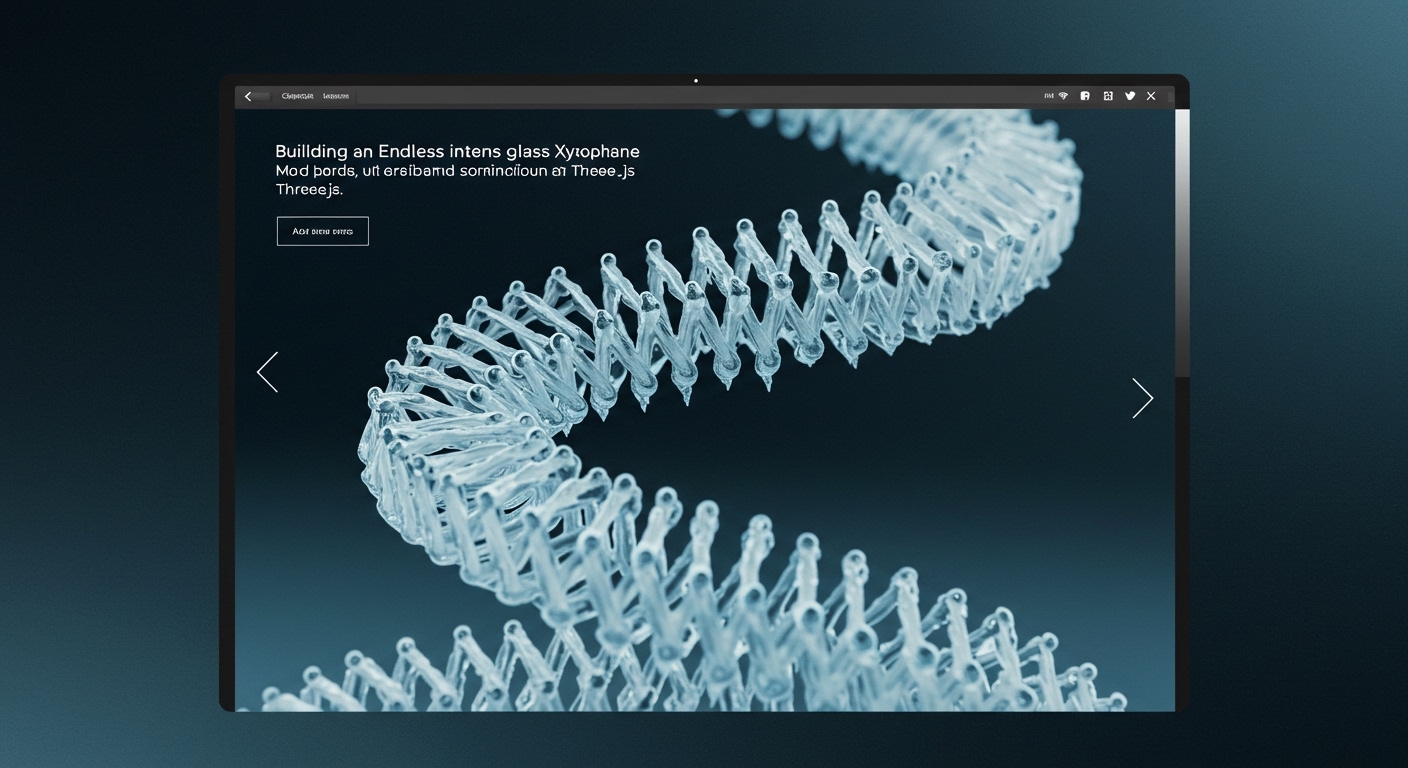
Consider Bonhomme, a studio known for crafting immersive digital experiences for luxury brands. Conventional wisdom often suggests that such visually dense, interactive projects are inherently detrimental to performance, requiring compromise on either richness or load times. This perspective, however, overlooks the growing native capabilities of the web platform. The detailed shader-based glass in the Three.js xylophone project, for instance, illustrates how complex visual effects can be achieved with minimal DOM overhead, focusing computation where it is most efficient: the GPU. Similarly, the upcoming sibling-index() animations, along with use cases for the infinity keyword in transitions and container “stuck” queries, enable highly responsive and context-aware motion and layout directly in CSS, offloading animation logic from JavaScript and potentially improving perceived performance. These tools provide the primitives for building experiences that are both intricate and efficient.
The prevailing industry focus on stripping down interfaces to their most minimal forms for speed, while well-intentioned, often misses the point that sophisticated visual language and interaction can be performant when implemented with modern techniques. The true craft lies not in elimination, but in intelligent implementation, leveraging browser-native strengths. It is an outdated notion that rich web experiences must be slow. For example, the precise control offered by gap decorations and the border-shape property in CSS empowers designers to create complex, distinctive layouts and components without relying on heavy image assets or JavaScript for shape manipulation. This allows for designs that are both visually unique and inherently performant. By mid-2027, the perceived performance penalty for highly styled and interactive interfaces will largely dissipate for projects that effectively leverage these native CSS and WebGL advancements, making what was once considered a luxury feature a standard expectation for compelling user experiences across a wider range of projects.
The primary resistance to this shift comes from established workflows and the continued reliance on frameworks that abstract away these lower-level CSS and WebGL controls, sometimes without fully optimizing for them. There is also a comfort within many design systems for simpler, box-model-constrained layouts, which can delay the adoption of properties like border-shape or sophisticated gap decorations, despite their native efficiency. The lingering perception that anything visually complex is “heavy” also hinders exploration of these new, performant native capabilities. Furthermore, a focus on “lowest common denominator” browser support, while sometimes necessary, can prematurely limit the adoption of features now gaining Baseline status, slowing innovation for the broader web.
A working web design professional should immediately integrate CSS gap decorations into their daily practice. Instead of solely relying on padding or margins for spacing, experiment with coloring, outlining, or giving unique backgrounds to the gaps themselves within a CSS Grid layout. This provides a new dimension of control over white space and visual separation that was previously complex or impossible, directly enhancing layout craft.
TL;DR
New CSS features and advanced rendering techniques are making complex, interactive web experiences performant and standard-compliant.
Curated References
About this editorial — This piece was developed using AI-assisted research and curation across multiple industry sources. All analysis, opinions, and predictions represent the editorial perspective of JHDD. Sources are linked in the references section above.