JHDD Interior Report — 2026.10.11
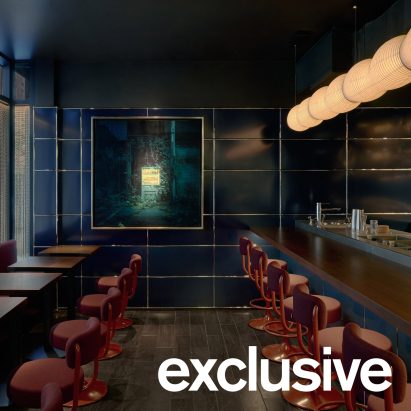
Josh Greenspan’s VV’s Cocktail Room in Manhattan uses Steel Blue USM Haller modular shelving to define almost its entire interior envelope. This represents a clear shift in how luxury design approaches spatial definition in compact, high-value locations.
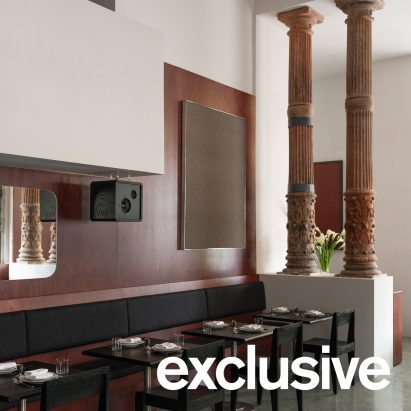
These recent projects – Formant Studio’s Nota Tavern, VV’s Cocktail Room, Didea’s Super F, Bétyle Studio’s Arcane 17, and Bar Shrimp – share a dedication to creating highly specific, often enclosed micro-environments. They embed strong material identities within existing architectural footprints, whether a former residence or a tower interior. The emphasis is on internal coherence, tactile depth, and a focused sensory experience rather than outward-looking transparency or expansive, fluid spatial programs.
Josh Greenspan’s application of USM Haller at VV’s Cocktail Room exemplifies this direction. The almost complete enclosure by the modular system creates a distinct, cloistered spatial tension, dictating a specific intimacy. This choice contradicts the widespread industry preference for ‘flexible’ or ‘transparent’ hospitality environments, which often prioritize open sightlines and adaptability. Instead of designing for broad visual access or easy reconfiguration, Greenspan commits to a singular, enveloping material expression. The tactile repetition of the Steel Blue modules not only defines the visual rhythm but also subtly directs human flow and interaction, encouraging a focused, contained experience. This approach suggests that genuine luxury in compact urban spaces is found not in maximizing perceived volume, but in intensely curating the immediate, haptic surroundings through deliberate material constraint. The sense of ‘arrival’ into a fully realized material world becomes the luxury, rather than an expansive vista.
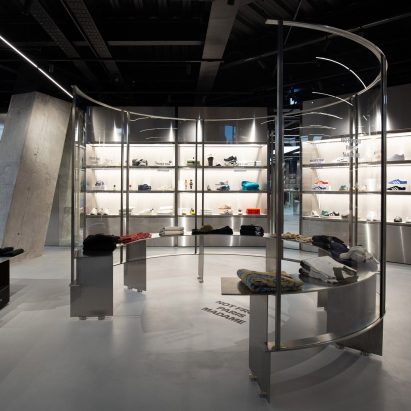
This commitment to distinct, enveloping materiality and precise spatial programming is further echoed by Didea’s design for the Super F streetwear store. Situated within ZHA’s Mercury Tower, the store utilizes a steel-clad, modular grid to create an interior that stands as an independent entity. Its internal spatial character and tension are derived purely from the grid’s precision and repeated elements, rather than from an engagement with the tower’s broader context or a desire for exterior views. This internal coherence reinforces the idea that perceived value and distinctiveness now stem from an inward focus on materiality and controlled spatial composition, rather than external factors or overt ‘transparency’. This trend towards intensely specific, materially unified environments will intensify. By mid-2027, more high-end commercial and hospitality establishments will overtly embrace these constrained, materially expressive interiors, utilizing singular material palettes to define their entire spatial identity, consciously moving further away from multi-material, visually fragmented schemes that attempt to be all things to all people.
This micro-environment trend faces resistance from developers prioritizing rapid leaseability over distinctiveness, who demand neutral, ‘white-box’ spaces. These entities often favor generic material specifications that allow for swift tenant turnover and minimal bespoke investment. The opposing force is the default expectation of bland, adaptable shells designed for mass appeal and lower common denominator aesthetics, as seen in many new commercial fit-out guidelines where a lack of specific character is deemed a virtue for market broadness.
Interior professionals should select one core material or tactile sensation and fully explore its spatial and psychological impact on a project. This means designing spatial flow and tension directly from the material’s inherent properties, rather than applying materials as surface finishes to a pre-determined layout. For instance, rather than simply specifying an acoustic panel for sound absorption, consider how Autex Acoustics panels, as seen at Bar Shrimp, could be laser-etched to also define the visual rhythm and tactile quality of an entire wall, influencing conversation dynamics and sound perception simultaneously within a tightly controlled environment.
TL;DR
Intentional constraint and singular material immersion are defining the next wave of luxury spatial experience in compact environments.
Curated References


About this editorial — This piece was developed using AI-assisted research and curation across multiple industry sources. All analysis, opinions, and predictions represent the editorial perspective of JHDD. Sources are linked in the references section above.