JHDD Interior Report — 2026.08.29
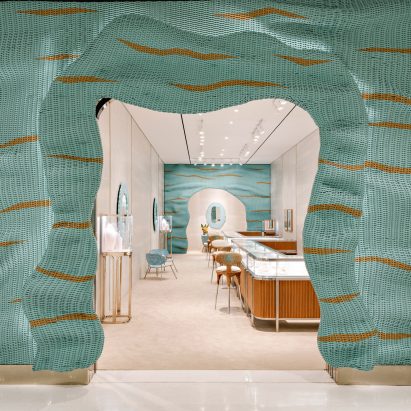
Estúdio Campana’s “woven jewellery box” for Tiffany & Co in São Paulo uses an undulating wicker facade in the brand’s signature blue.
This singular focus on a bespoke, tactile skin suggests a broader industry pattern. Recent projects, including Astet Studio’s work at Aethos London Shoreditch and Richard Parr Associates’ renovation of Yarlington Lodge, reveal a deliberate engagement with material history and sensory contrast. This is not simple preservation or aesthetic blending; it is a calculated negotiation between disparate material languages, often within existing architectural envelopes. These designs cultivate a specific spatial tension by making the interaction of materials and eras visible.
Consider Astet Studio’s approach to Aethos London Shoreditch. The design specifically melds the industrial language of the original Ron Arad Associates building with a Japanese-inspired softness. Mainstream luxury design often prioritizes a unified, often monolithic brand aesthetic or a smooth historical pastiche. However, Astet Studio’s method generates spatial tension by allowing the original building’s industrial raw honesty to confront a refined, tactile overlay. This challenges the conventional wisdom that spatial harmony comes from minimizing visible material and historical friction. Instead, a richer human experience emerges from the active dialogue between these distinct material characters. This deliberate material counterpoint avoids the sanitized blandness that can result from overzealous attempts at seamless integration. The spatial experience becomes more compelling when occupants perceive and interact with these distinct layers, rather than a singular, undifferentiated surface.
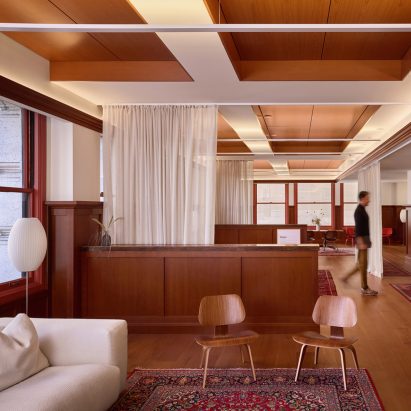
This pursuit of inherent material friction, rather than its dissolution, redefines luxury. IA’s integration of Craftsman detailing with minimalist technical elements within San Francisco’s 1907 Monadnock Building for Notion further illustrates this. The juxtaposition creates a legible history on site, a conscious acknowledgment of the structure’s past meeting its present function. By early 2028, leading firms will explicitly articulate design proposals that champion this material friction, showcasing how new interventions deliberately underscore, rather than erase, the existing material narrative. This will extend beyond mere surface treatments, influencing how structural elements are exposed, how light interacts with aged versus new textures, and how human flow is guided through these layered environments.
The commercial pressure for rapid project turnover and cost-efficient standardization directly opposes this nuanced, site-specific approach. Developers frequently seek “signature styles” that can be quickly replicated across different geographies and building types, thereby diluting the unique material tension that arises from a deep engagement with a singular context. This drives a superficial application of materials, favoring quick visual impact over durable, complex tactile relationships.
Interior professionals should begin every project with a detailed, almost archaeological, material audit of the site’s existing fabric. Document not only the visible finishes but also the structural honesties, the patinas of age, and the inherent properties of the original construction. Then, instead of defaulting to covering or replacing, identify specific opportunities where new material interventions can deliberately create a resonant contrast with the discovered elements. This means selecting new materials for their ability to articulate a new chapter, not just to blend in.
TL;DR
The most compelling luxury interiors now deliberately articulate material and historical friction rather than attempting to smooth it away.
Curated References



About this editorial — This piece was developed using AI-assisted research and curation across multiple industry sources. All analysis, opinions, and predictions represent the editorial perspective of JHDD. Sources are linked in the references section above.