JHDD Interior Report — 2026.08.25
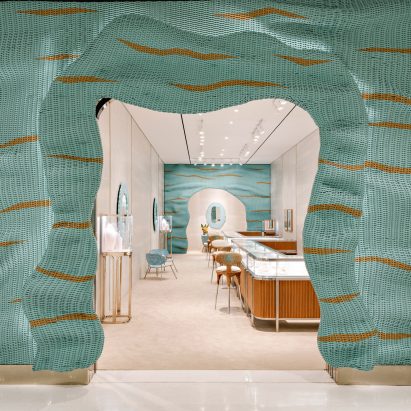
Estúdio Campana created a woven wicker skin for the Tiffany & Co pop-up store in São Paulo, shaping an undulating facade in signature blue.
This particular approach, along with the recent refurbishments at Yarlington Lodge and the Fairmont Hotel, reveals a deeper professional re-engagement with inherent material qualities and site-specific textural narratives. These projects move beyond mere aesthetic updates, seeking instead to weave tangible histories or crafted textures directly into the spatial experience, even in temporary or high-traffic commercial settings.
The choice of woven wicker for Tiffany & Co, a global luxury brand often associated with polished surfaces and high-gloss finishes, is not merely a stylistic flourish. It represents a subtle, yet significant, pivot towards acknowledging materiality as a primary communicator of brand identity and spatial comfort. Conventional industry wisdom often prioritizes sleek, readily repeatable materials for luxury retail environments, aiming for universal recognition and minimal maintenance. However, the Campana brothers’ approach embraces the irregularity and tactile warmth of natural fibers, creating a distinct haptic signature that invites closer interaction. This contradicts the prevailing belief that digital-first retail experiences diminish the need for profoundly physical, high-craft materiality in physical stores. Instead, it suggests that the more digitally saturated daily life becomes, the more vital these grounded, sensory experiences become within the built environment.
This emphasis on material integrity and crafted tension extends beyond the surface. For the interior professional, the interplay between the wicker’s organic form and the underlying brand rigor creates a layered spatial quality. It suggests that even temporary installations can hold significant influence over perceptions of permanence and authenticity. Mainstream retail design often defaults to easily manufactured panels or synthetic textures to quickly convey luxury. However, this project, with its unique material narrative, highlights that true distinction now arises from the depth of a material’s story and its physical presence. It is anticipated that by mid-2027, luxury brands will increasingly invest in bespoke, natural, or upcycled material installations, even for short-term activations, moving away from purely engineered or pre-fabricated elements. This shift will be driven by a recognition that experiential value, not just visual branding, commands client attention and loyalty.
The most direct opposing force to this deeper engagement with materiality and site-specific craft is the ubiquitous “dopamine decor” trend, as critiqued by Julie Lasky. This trend, driven by social media algorithms and the relentless pursuit of novel, visually arresting content, promotes superficial stylistic changes over substantive material or spatial considerations. It prioritizes immediate, fleeting visual gratification and hyper-saturated aesthetics, often at the expense of genuine tactile quality, human flow, or long-term spatial comfort.
Interior professionals should critically re-evaluate their material palettes, moving beyond conventional choices to explore locally sourced, hand-finished, or contextually resonant materials. Instead of specifying standard veneers or off-the-shelf wall coverings, consider integrating artisanal techniques, upcycled components, or raw, minimally processed textures that directly respond to the project’s geographic or historical context. This means investing time in understanding the provenance and inherent qualities of materials, not just their surface appearance or perceived cost-efficiency.
TL;DR
The future of luxury interiors lies in authentic material presence and crafted texture, not superficial trends.
Curated References



About this editorial — This piece was developed using AI-assisted research and curation across multiple industry sources. All analysis, opinions, and predictions represent the editorial perspective of JHDD. Sources are linked in the references section above.