JHDD Architecture Report — 2026.10.16
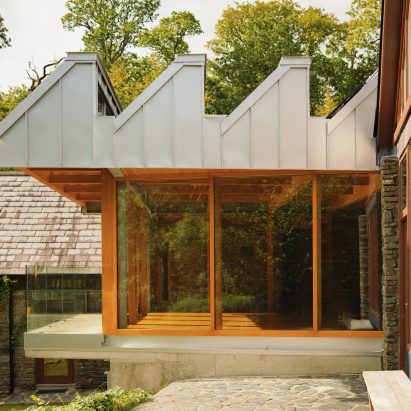
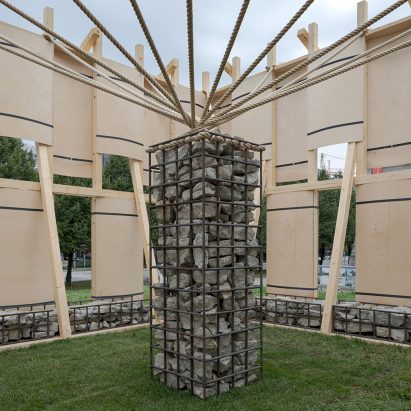
Schemata Architects connected two existing stone buildings at Linden House with a timber- and steel-framed yoga studio. This direct integration of distinct material systems within a protected ecological area like Dromgarriff Rainforest highlights a re-emerging pattern in design: a conscious negotiation with existing conditions rather than an imposition of newness. Across projects such as the temporary Resonance pavilion by Aru Ma- Architects, which uses limestone and plywood, and the Centre Pompidou Francilien – Fabrique de l’Art’s monolithic conservation vault, the deliberate expression of material choices is a central theme. This trend extends beyond mere aesthetic preference, signaling a deeper re-evaluation of architecture’s relationship with its site and its lifecycle.
The ongoing work by Bohlin Cywinski Jackson, as explored in the book A Long View, showcases residential design that prioritizes site-specific material expression, from rustic retreats in Ontario to Pittsburgh transformations. The mainstream industry often champions novel material development for its perceived sustainability benefits or aesthetic versatility. However, the true material innovation does not always lie in developing new composites or smart surfaces with high-tech claims. Instead, it resides in the intelligent, honest deployment of established materials, understanding their inherent properties, structural capacities, and environmental impact in specific contexts. The perceived “simplicity” of limestone and plywood in the Resonance pavilion, for example, is often misconstrued as a lack of ambition. This view overlooks the sophisticated structural philosophy and deep material knowledge required to extract maximum performance and integrity from such basic components, particularly when designing for temporary installations with demanding public presence and an emphasis on eventual deconstruction.
This material honesty extends directly to urban responsibility and structural philosophy. The Centre Pompidou Francilien – Fabrique de l’Art, with its precisely controlled “sealed monolith” for conservation, demonstrates an extreme end of material performance expectation, but even here, the material choice for such a vault is integral to its structural and environmental stability. The book Typological Drift: Emerging Cities in China, detailing rapid urbanization in the Pearl River Delta and Yangtze River Delta, often implicitly suggests that the scale and speed of development necessitate a departure from traditional, site-responsive practices. This is a false dichotomy. By mid-2027, the industry will see a rise in modular construction systems that leverage locally sourced, low-processed materials not primarily for cost savings, but for their inherent structural integrity, reduced embodied carbon, and the capacity to adapt to diverse urban fabrics. These systems will not mimic a pre-industrial aesthetic but will reinterpret regional material palettes with advanced computational design for optimized structural performance, material expression, and waste reduction throughout their lifecycle.
The primary opposing force to this integrated material and urban philosophy comes from speculative real estate development, which frequently prioritizes rapid deployment, standardized components, and generic material finishes over context-specific structural or material integrity. This force often manifests as pressure on design professionals to adopt a “lowest common denominator” approach, where material choice is dictated by immediate cost rather than long-term environmental or social value. It resists the time investment required for detailed site analysis and bespoke material sourcing.
Architecture professionals should, this week, identify one recent project in their studio where a material specification was driven by cost or convention. Re-evaluate that material through the lens of its local availability, its embodied energy from cradle to gate, and its potential for reuse or end-of-life recovery. Then, research a structurally equivalent alternative material that performs better on two of those three criteria, even if it requires a slight deviation from standard construction assemblies. This exercise moves beyond theoretical understanding to practical application of material honesty.
TL;DR
Honest material deployment and structural philosophy are critical to urban and ecological responsibility, challenging quick-build development models.
Curated References
About this editorial — This piece was developed using AI-assisted research and curation across multiple industry sources. All analysis, opinions, and predictions represent the editorial perspective of JHDD. Sources are linked in the references section above.