JHDD UI UX Report — 2026.08.19
WebAIM’s 2026 report revealed that 95.9% of the top one million home pages contain accessibility errors.
This persistent failure rate, alongside accounts of AI accelerating development cycles, illustrates a critical disconnect within product design. While engineering and prototyping leverage new technologies to increase output speed, fundamental aspects of user experience, like validation and accessibility, are either lagging behind or being actively deprioritized. The drive for rapid iteration, often fueled by AI capabilities, frequently bypasses essential design principles, creating a superficial sense of progress rather than genuine user-centered improvement.
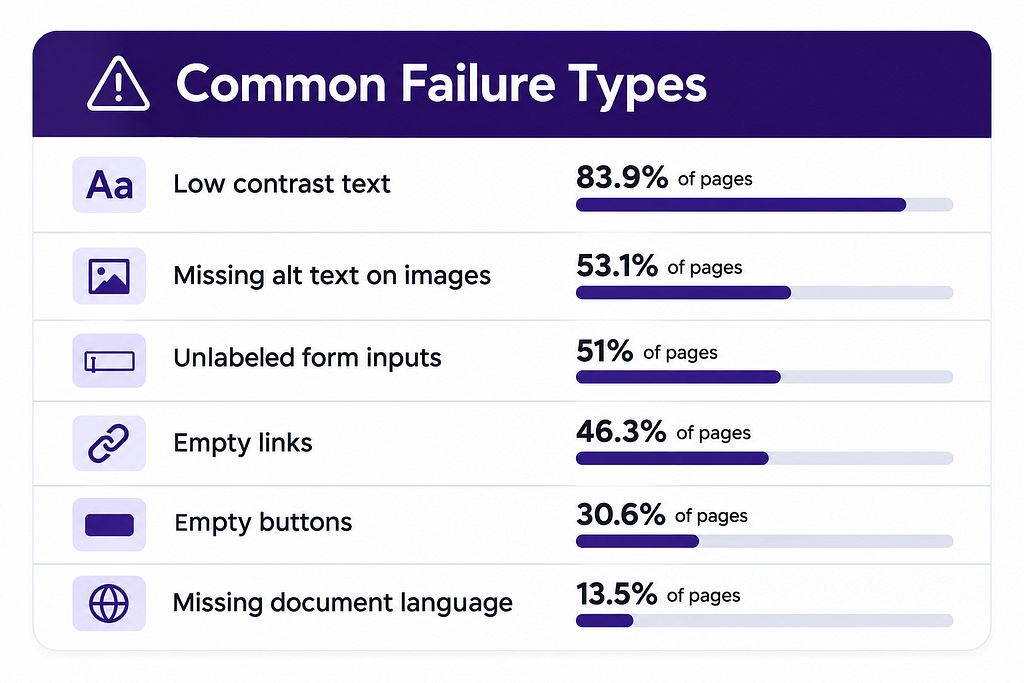
The WebAIM report’s finding that the six most common failure types have remained unchanged for seven years directly challenges the mainstream industry belief that technological advancement inherently leads to better design. Many in the industry frame accessibility as a compliance burden or a separate skill set, a view contradicted by the report’s emphasis that these persistent errors relate directly to basic design principles: contrast, labeling, and meaningful content. This suggests that the issue is not a lack of specialized knowledge, but a systemic failure to integrate foundational usability into core design practices and workflows.
The pressure to “ship faster,” often discussed in the context of AI’s impact on build times, frequently overshadows the crucial need for robust user research and validation. While platforms like Optimal emerge to help teams “validate at the same pace” as AI-accelerated development, the core issue remains: if fundamental design considerations, like those highlighted by WebAIM, are not integrated from the start, faster validation merely identifies flaws more quickly, or worse, solidifies flawed interaction patterns. The mainstream industry opinion that rapid iteration via AI guarantees better user outcomes is misguided; without a parallel commitment to foundational design principles, speed alone leads to accelerated accumulation of poor user experiences. Within two years, organizations that prioritize AI-driven velocity over the inherent quality and accessibility embedded within their design systems will face significant user churn and legal repercussions.
This resistance to integrating fundamental design principles often stems from the “mechanical thinking” described by Darren Yeo in design leadership, where the focus remains on “cross-functional alignment, product development and operations, and predicting roadmaps.” Such a mindset prioritizes output metrics and timelines over the intrinsic quality of the user experience, seeing accessibility or in-depth user research as potential bottlenecks rather than core components of product success. The pressure from executives to pivot strategy or adopt new AI features without corresponding shifts in design process exacerbates this problem.
A working UI UX professional should proactively integrate accessibility checks directly into their prototyping and design system contributions this week. This means treating contrast ratios, meaningful labeling, and clear interactive element states as non-negotiable requirements within every component and flow, rather than an audit item for later. Leverage existing guidelines and tools to ensure these checks are part of the iterative design process.
TL;DR
The rush for AI-driven speed is exposing, not solving, persistent failures in fundamental user research, accessibility, and design leadership.
Curated References



About this editorial — This piece was developed using AI-assisted research and curation across multiple industry sources. All analysis, opinions, and predictions represent the editorial perspective of JHDD. Sources are linked in the references section above.