JHDD Interior Report — 2026.10.14
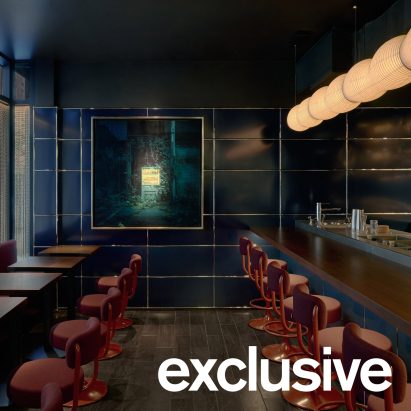
Josh Greenspan’s VV’s Cocktail Room in Manhattan, built almost entirely from Steel Blue USM Haller modules, presents a highly defined spatial proposition.
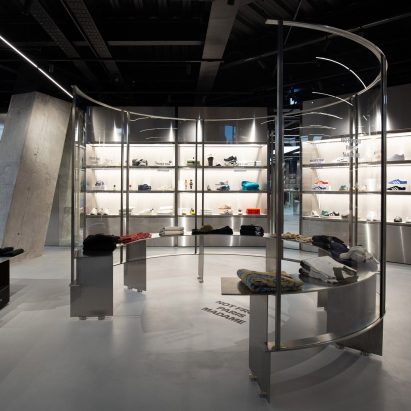
Across recent projects, from Formant Studio’s Nota Tavern in Mexico City reinterpreting classic taverns to Didea’s steel-clad Super F store inside ZHA’s Mercury Tower, designers are making declarative statements with material and form. These interventions often insert specific, even rigid, systems or highly customized elements into existing, often historically significant or architecturally distinct, envelopes. This approach prioritizes a singular, controlled experience over ambiguous flexibility, directing human flow and interaction through explicit material choices and spatial tensions.
The design of VV’s Cocktail Room exemplifies this direction. While modular systems like USM Haller are frequently lauded for their adaptability and reconfigurability, Greenspan’s application is not about infinite flexibility for the end-user. Instead, the near-monolithic use of Steel Blue modules dictates a very particular, almost contained, human flow and atmosphere. This contradicts the mainstream perception of modularity primarily as a tool for user-driven customization or seamless integration. Here, the modularity becomes a fixed, tactile envelope, creating a deliberate spatial tension. The rigid system firmly defines the intimate, 18-seat environment, where movement is guided and interactions are confined within a structured framework. This isn’t about an open, flowing space, but about a curated, almost architectural, experience. The choice of a singular, industrial material system becomes the primary driver of both aesthetic and functional experience, asserting its presence rather than blending into the background.
This prescriptive material choice creates an inherent spatial tension that is central to the design. Patrons navigate a space where surfaces are uniform, precise, and highly defined, directly influencing how they perceive boundaries, proximity, and their own movement. The tactile quality is not one of softness or organic flow, but of cool, precise, engineered interaction, encouraging a specific mode of engagement with the environment. This focus on material rigidity and directed spatial experience will become a more conscious and celebrated design strategy. The friction generated by inserting a distinct, unyielding material system into a broader context is increasingly being embraced as a design asset. By mid-2027, designers will increasingly specify systems for their inherent and unyielding material qualities and their ability to control the spatial narrative, rather than for their theoretical adaptability. Projects will prioritize designs that force a specific mood and interaction, embracing the deliberate friction created by highly specific material installations to shape occupant behavior.
This deliberate, sometimes confrontational, design approach faces resistance from the prevailing desire for open-plan neutrality and perceived maximum commercial flexibility. Many developers and some end-users continue to seek spaces that serve as a chameleon backdrop for various functions or tenant styles, fearing that a highly opinionated material or spatial intervention will limit broad appeal.
Interior professionals should begin by analyzing existing architectural contexts with an eye toward introducing a singular, robust material system or custom fabrication that creates a specific, non-negotiable human flow. This involves experimenting with how the inherent properties of materials like steel, concrete, or specific modular units can dictate spatial tension and tactile engagement, rather than merely accessorizing a space. Consider how to make the material itself a primary agent of spatial storytelling.
TL;DR
Designers are using specific material systems and custom interventions to create defined spatial experiences and direct human interaction within existing structures.
Curated References
About this editorial — This piece was developed using AI-assisted research and curation across multiple industry sources. All analysis, opinions, and predictions represent the editorial perspective of JHDD. Sources are linked in the references section above.