JHDD 3D Modeling Report — 2026.08.04
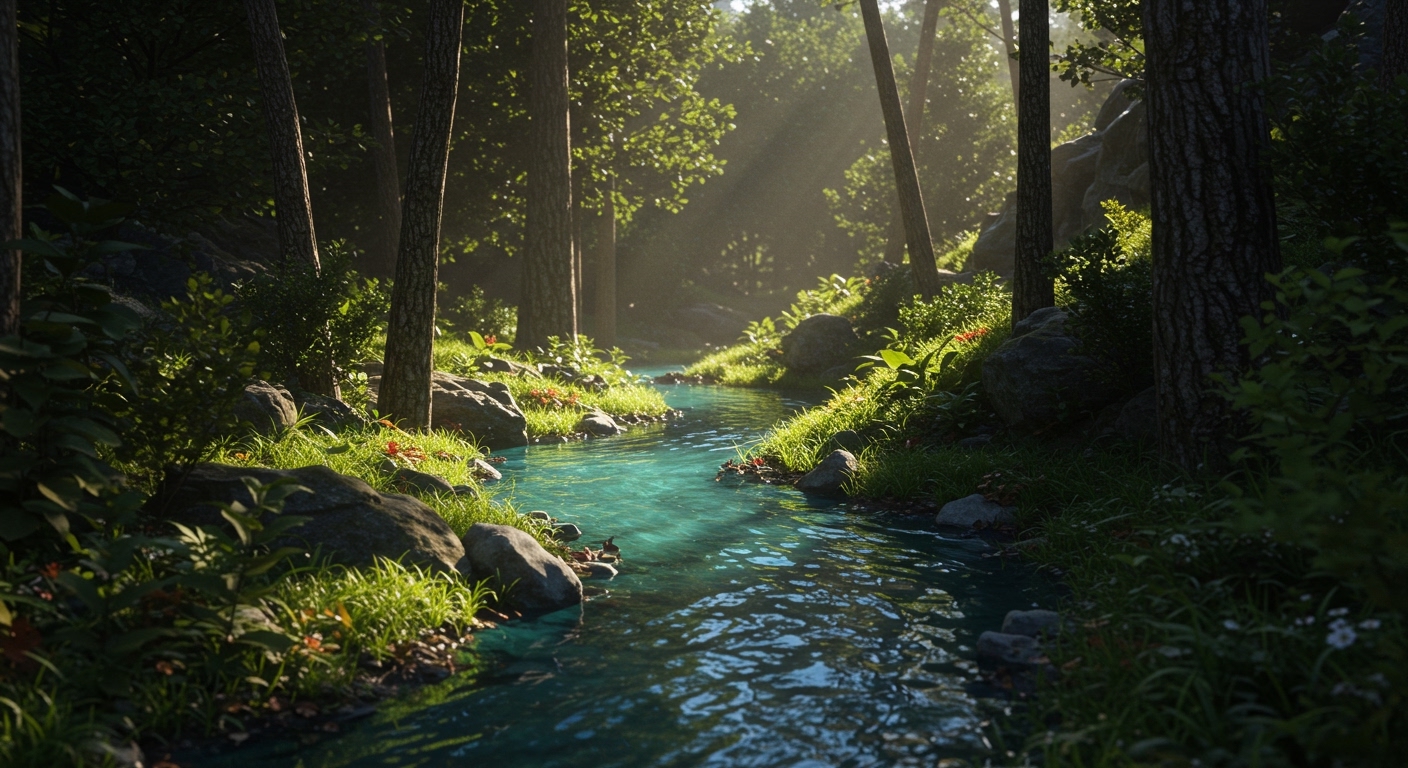
Enrique De la Garza’s recent Houdini simulation of a forest stream demonstrates a heightened pursuit of hyper-realism in natural environments. This pursuit is not isolated. A distinct pattern connects the ongoing drive for sophisticated procedural generation, exemplified by De la Garza’s work and Casey Sheep’s extensive Blender VFX add-on, with the re-emergence of legacy digital interfaces and the definitive shift towards entirely virtual content delivery. These convergent forces suggest a complex interplay where advanced digital fabrication tools are being harnessed to enrich, or even resurrect, familiar digital experiences, redefining the relationship between creation, context, and consumption within emerging virtual spaces.
The mainstream industry opinion often postulates that the evolution of hyper-realism and procedural systems, such as those masterfully employed by De la Garza, primarily serves the creation of entirely new, expansive virtual worlds. This perspective, while valid for some applications, overlooks a critical counter-current emerging from market signals. The simultaneous interest in reviving platforms like the social network of the mid-2000s, hinted at by its owners, or Winamp’s re-launch with Deezer, suggests that the true frontier lies in applying these cutting-edge capabilities to imbue existing or nostalgic virtual spaces with unprecedented fidelity. The goal is not merely to invent novel digital landscapes but to elevate the perception and engagement within familiar digital structures. This strategy leverages the inherent comfort and established user paradigms of older interfaces while delivering the compelling visual impact achievable with modern spatial computing and advanced lighting dynamics. This approach grounds the user experience in recognizability, making the leap into hyper-real virtual environments less disorienting and more emotionally resonant.

Consider the ramifications of Sony’s cautious move to phase out PlayStation physical discs. This strategic shift underscores a decisive commitment to fully digital content consumption within evolving virtual environments. This digital-only distribution model directly facilitates dynamic content updates and personalized experiences, which are crucial for re-contextualizing established virtual spaces. By mid-2027, it is highly probable that game developers and platform holders will increasingly offer ‘legacy environment’ packages or adaptive filters. These will utilize advanced procedural techniques to render historical digital interfaces or game settings with a hyper-realistic sheen previously unattainable, rather than focusing solely on brand-new intellectual property. Such offerings will feature highly dynamic lighting dynamics and granular material realism designed not to create wholly novel settings, but to deepen immersion within retro-inspired virtual spaces, effectively turning nostalgia into a canvas for cutting-edge digital art. These hyper-realistic retro environments could include procedurally generated wear and tear, or dynamic weather systems that adapt to simulated historical conditions.
The primary opposing force to this trend of enriching familiar digital spaces with hyper-realism is the inherent demand for computational resources and the resulting complexity in asset optimization. Generating and rendering photorealistic environments with complex global illumination and nuanced material shaders, especially when these elements are procedurally adapted for various legacy aesthetics, imposes significant burdens on client hardware and network bandwidth. This challenge requires robust optimization strategies, including efficient streaming techniques and intelligent level-of-detail management, to ensure seamless experiences across diverse hardware configurations. Without addressing this friction, the promise of hyper-realistic legacy environments risks fragmentation, where only users with top-tier spatial computing devices can fully appreciate the intended fidelity, limiting broad access and adoption.
A working 3D Modeling professional should dedicate time this week to exploring techniques for deconstructing and re-contextualizing existing 3D assets. This involves identifying how geometry, textures, and material properties can be broken down into modular, procedurally adaptable components. Professionals should specifically focus on how lighting dynamics can be manipulated through procedural tools to evoke particular eras or moods, moving beyond a singular pursuit of absolute photorealism. Mastering this adaptability will be crucial for creating content that transcends purely novel environments and instead breathes new, hyper-realistic life into established virtual forms.
TL;DR
Advanced procedural realism is increasingly being applied to both new and legacy digital spaces, requiring adaptable asset management.
Curated References
About this editorial — This piece was developed using AI-assisted research and curation across multiple industry sources. All analysis, opinions, and predictions represent the editorial perspective of JHDD. Sources are linked in the references section above.