JHDD UI UX Report — 2026.06.17
At Highnote, the creation of user trust depends less on branding and more on the intentional design of micro-moments.
The common thread through recent industry commentary points to a significant gap between perceived design impact and actual user experience. Whether discussing the fundamental architecture of AI products, the painstaking build-up of trust in financial platforms, or even the outdated formats of design portfolios, the focus consistently shifts away from surface-level aesthetics toward the subtle, often overlooked interaction patterns that define true usability and user confidence. Design is grappling with elements traditionally left to engineering or assumed as implicit.
The concept of Probabilistic Design, as described in recent discussions, advocates for accepting uncertainty and interpreting AI outputs with nuance. This directly contradicts the prevailing industry tendency to treat AI-driven suggestions or predictions as definitive solutions ready for immediate implementation. Many design teams approach AI integration as a means to automate decision-making or generate assets, often believing that predictive algorithms offer a shortcut to deep user understanding or optimal interface states. This perspective, however, overlooks the inherent variability of user behavior, contextual shifts, and the limitations of model training data. Designers frequently present AI-powered solutions with an unearned air of certainty, driven by impressive data visualizations or confident model outputs, but fail to embed mechanisms for adaptive feedback loops or the systematic evaluation of probabilistic outcomes within the user interface itself. This approach fosters a brittle user experience, where an AI’s misinterpretation or a low-confidence prediction can quickly erode user trust and disrupt workflows.
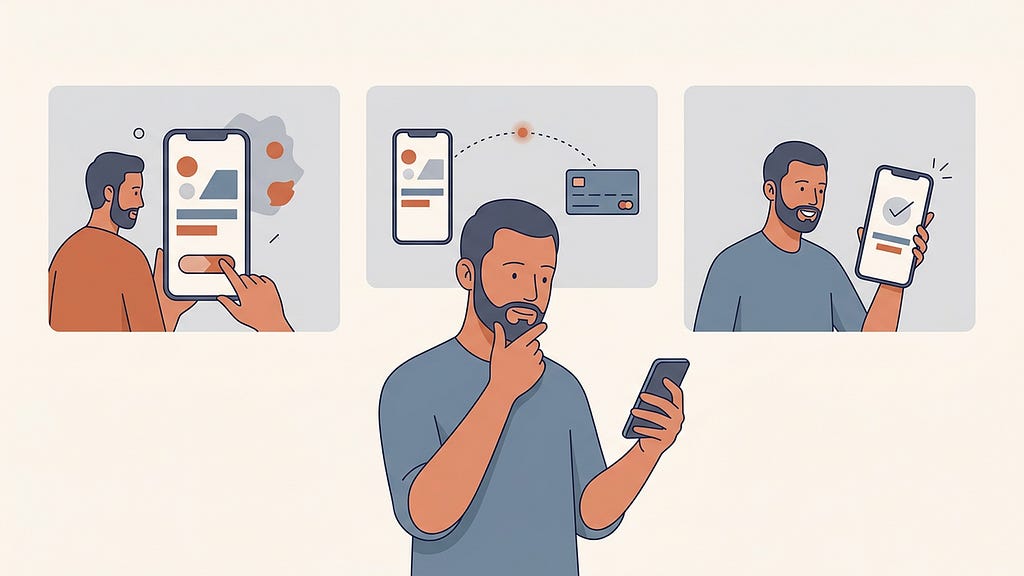
A studio like PayPal, with its extensive experience in high-stakes financial interactions, understands the gravity of these small moments, even if the broader industry narrative often prioritizes visually striking interfaces or brand campaigns. The critical interactions that truly build and maintain trust in financial products are not the splash screens or marketing visuals; they are the subtle visual cues on a transaction history indicating pending status, the precise clarity of a loading spinner during a payment submission, or the immediate and actionable feedback provided after an unsuccessful attempt. These are the “micro-moments” that, despite their profound impact on user confidence and retention, frequently fall into the domain of engineering specifications or default system behaviors rather than explicit, intentional design. This oversight becomes particularly acute when integrating AI, as the system’s “understanding” of a user’s intent or state is rarely a certainty. By mid-2027, design systems will increasingly incorporate probabilistic interaction patterns, providing explicit guidance for handling uncertain states, system delays, and AI-driven recommendations that explicitly communicate varying degrees of confidence, moving beyond binary success/failure states.
The primary resistance to this necessary shift comes from deeply ingrained organizational structures, established design system frameworks, and product roadmaps that prioritize the delivery of visible features and aesthetic consistency over the deep, iterative refinement of granular interaction details. Teams are often measured on delivering tangible functionalities and meeting measurable KPIs typically tied to completion rates of primary flows. This focus leaves the subtle yet critical elements of system reliability, transparent uncertainty, and proactive micro-feedback loops consistently under-resourced or entirely undiscussed in strategic planning. The allure of a seemingly complete design system often overshadows the ongoing need to explicitly design for edge cases, error states, and the inherent unpredictability of real-world user interaction.
A UI UX professional should this week identify three “engineering details” in their current product’s most critical user flow – such as an API loading state, an error message interaction, or a system delay notification – and formally propose treating them as primary design problems, complete with user research questions and interaction flow diagrams, moving them out of implicit engineering decisions.
TL;DR
True design impact increasingly resides in the deliberate crafting of subtle, probabilistic interactions, especially with AI, rather than just visible features or brand consistency.
Curated References



About this editorial — This piece was developed using AI-assisted research and curation across multiple industry sources. All analysis, opinions, and predictions represent the editorial perspective of JHDD. Sources are linked in the references section above.