JHDD Interior Report — 2026.10.16
Josh Greenspan and USM’s VV’s Cocktail Room in Manhattan challenges conventional wisdom about modular systems in intimate spaces.
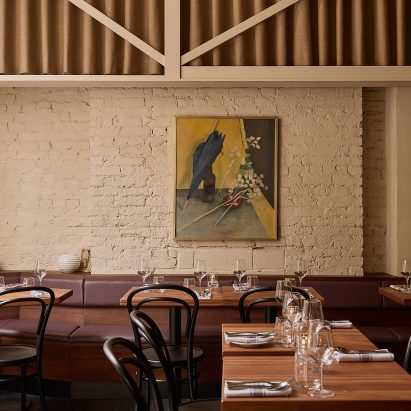
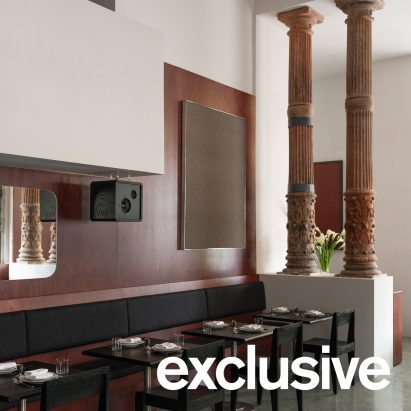
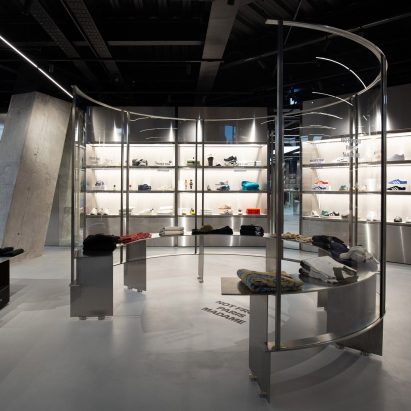
Across recent projects, from Didea’s steel-clad Super F store inside ZHA’s Mercury Tower to Gundry & Ducker’s Parisian-style Cassette bistro within a Grade II-listed building, a distinct pattern emerges: the deliberate insertion of a highly defined, often singular, material system into a pre-existing, architecturally assertive envelope. This is not about blending or seamless integration; it is an assertive overlay, where the new interior establishes its own robust material language in direct, sometimes confrontational, dialogue with its historic or iconic host structure.
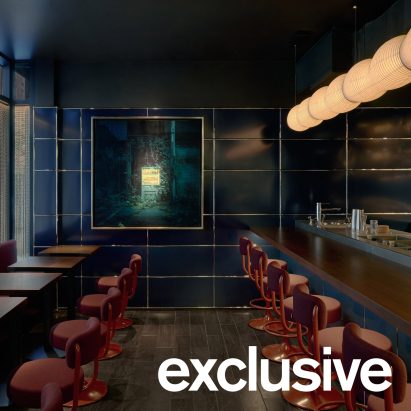
VV’s Cocktail Room, wrapped almost entirely in Steel Blue USM Haller modular shelving, serves as a prime example of this strategy. Mainstream industry opinion frequently positions modular furniture systems as inherently flexible, adaptable, or cost-efficient solutions designed to maximize utility or provide a neutral backdrop. However, in Greenspan’s project, the USM Haller system transcends mere functionality. Its pervasive, consistent application defines the entire interior volume, creating a specific, almost hermetic intimacy for just 18 seats. This singular material choice dictates the tactile quality of the space, promoting a focused sense of enclosure rather than expansive flexibility. It sculpts the human flow not by guiding movement around objects, but by immersing occupants within a defined material field, making the modularity itself the primary spatial experience.
This approach contradicts the prevalent idea that comfort in small, luxury spaces demands softness, varied textures, or bespoke, organic forms. Instead, VV’s leverages a strict material uniformity to cultivate a powerful, coherent spatial tension, deriving its luxury from the precision and self-contained nature of its design. The rigid geometry and unyielding surface of the steel shelving create an unexpected depth, inviting closer engagement with the contained experience. This principle, where a strong, singular material system establishes the entire character and flow of an inserted space, will become a benchmark for luxury micro-hospitality concepts globally by early 2028.
The primary opposing force to this trend is the persistent industry preference for “biophilic” or “seamless” approaches. These often employ natural materials, organic forms, and muted palettes to soften edges and reduce visual friction, particularly in residential projects or broader hospitality ventures seeking universal appeal. This tendency frequently dilutes powerful, specific spatial concepts into a generically comforting aesthetic that avoids strong material statements or deliberate spatial friction. This dilutes the potential for truly memorable tactile and spatial experiences.
For upcoming projects within existing architectural shells, interior professionals should identify one singular, dominant material or modular system early in the design process. Design efforts should then explore how this chosen element can establish an assertive, deliberate dialogue with the existing structure, rather than attempting to diffuse, integrate, or harmonize new elements passively. Focus on how this singular material dictates tactile experience and human flow.
TL;DR
Designers are using distinct, often modular, material systems to create deliberate spatial tension within existing structures, redefining intimacy and flow.
Curated References
About this editorial — This piece was developed using AI-assisted research and curation across multiple industry sources. All analysis, opinions, and predictions represent the editorial perspective of JHDD. Sources are linked in the references section above.