JHDD Architecture Report — 2026.09.01
António Costa Lima Arquitectos’ Praia do Bom Sucesso project in Lisbon concretely demonstrates the value of structural integrity as a palimpsest.
Across seemingly disparate architectural efforts, from the retrofitting of existing educational facilities to the infill of urban residential blocks and the academic discourse surrounding modernism, a consistent pattern emerges: a profound re-engagement with the intrinsic value of existing material and structural legacies. This approach transcends simple adaptive reuse; it represents a deep philosophical commitment to extracting new functional, aesthetic, and ethical value from what already exists, rather than perpetually seeking out pristine conditions or entirely novel material syntheses. The emphasis shifts from the architectural object as an isolated statement to its role within a continuum of material and urban evolution.
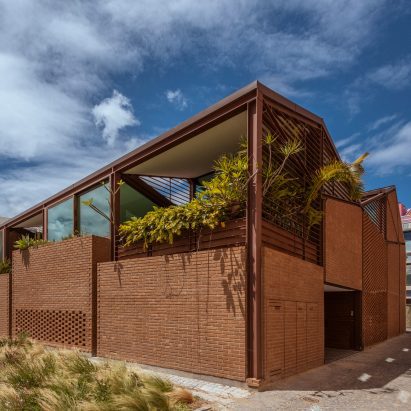
The Praia do Bom Sucesso project, with its retained facade of an old warehouse and new industrial-feeling structure of exposed brickwork and weathered steel, embodies a structural philosophy that prioritizes explicit material dialogue. This challenges the prevailing industry tendency to mask structural elements for a sleek, unified aesthetic or to indiscriminately replace old components without acknowledging their inherent value. Mainstream practice often treats exposed structure as a stylistic choice or a cost-saving measure; here, it functions as an ethical stance. The weathered steel and visible brickwork are not merely decorative; they articulate the building’s functional history and urban narrative, asserting that a building’s past is integral to its present and future. It is a layered intervention, where the urban context is treated as a dynamic, evolving organism, not a static backdrop.
This commitment to material honesty, where new interventions visibly acknowledge their historical predecessors, provides a more sustainable and robust structural pathway. It facilitates future adaptations without compromising the building’s core identity. Rather than pursuing an elusive architectural immortality through impervious skins, this methodology embraces the processes of aging, weathering, and subsequent modification. By mid-2027, JHDD anticipates a significant redefinition in how public procurement for urban infill projects evaluates proposals. There will be an increased emphasis on detailed material and structural provenance reports, actively influencing design choices to explicitly integrate existing material histories into new building skins and structural systems. This shift will favor the nuanced, layered solutions exemplified by Praia do Bom Sucesso over monolithic new constructions.
The primary resistance to this integrated material philosophy comes from the accelerated financial models of speculative real estate development. These models frequently prioritize rapid deployment and minimum initial capital expenditure, which often leads to the demolition of existing structures rather than engaging with the complexities of adaptive reuse. Existing urban fabric is often perceived as a constraint rather than a resource. Furthermore, rigid municipal zoning ordinances and prescriptive building codes can inadvertently hinder innovative material integration by prioritizing standardized aesthetics or material palettes over performance-based outcomes, thus stifling the nuanced, context-specific interventions required for projects like the Santa Maria School retrofit.
Architecture professionals should immediately begin conducting detailed material and structural audits for every project, regardless of its initial scope. These audits must extend beyond basic condition assessments, documenting material provenance, embodied energy, and the potential for visible integration into new design layers. This practice elevates the existing structure from a constraint to a primary design driver, fostering a proactive and tangible material honesty in all future interventions.
TL;DR
Visible material and structural layering in urban projects creates enduring value by honoring history and enabling future adaptation.
Curated References

About this editorial — This piece was developed using AI-assisted research and curation across multiple industry sources. All analysis, opinions, and predictions represent the editorial perspective of JHDD. Sources are linked in the references section above.