JHDD Interior Report — 2026.09.26
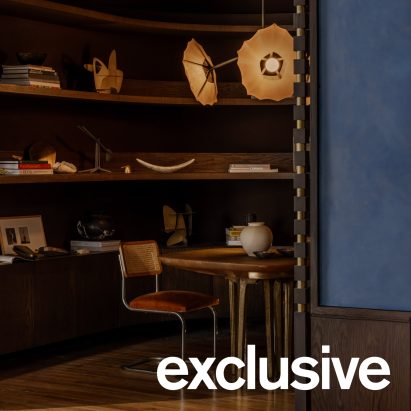
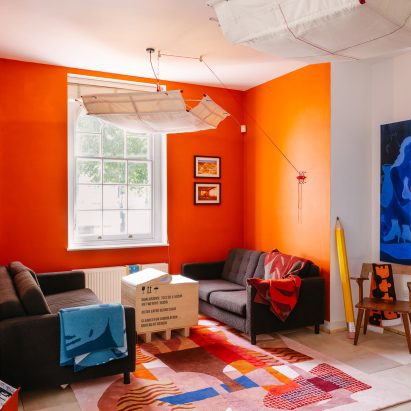
Federico Stefanovich’s renovation of his studio in Mexico City’s Edificio Humboldt to highlight his expressive metal lighting collection reveals a deliberate focus on the interplay between old structures and new materialities. This project, alongside Apple’s 600-seat Music Hall in Battersea Power Station, I IN’s work for Andersson Bell in Tokyo, and UAL’s Atterbury Flat, signals a prevailing pattern: designers are not merely adapting existing buildings, but actively exploiting their inherent spatial tension and established material palettes to forge distinct, often contrasting, sensory experiences for human flow. This engagement moves beyond simple preservation or functional update, aiming for a heightened, specific interaction with place.
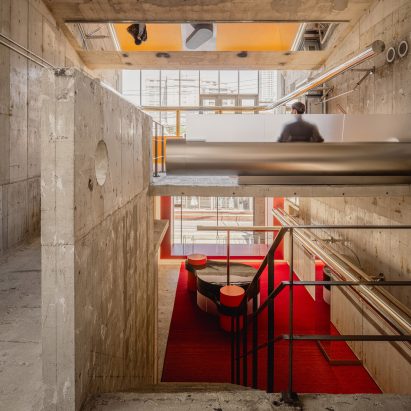
I IN’s design for the Andersson Bell Tokyo store exemplifies this precise methodology. By retaining the original 1993 building’s exposed concrete interior and contrasting it sharply with glossy, reflective surfaces and warm red and yellow hues, the studio creates a palpable friction. This is not simply a stylistic choice; it is a calculated manipulation of tactile and visual information. The polished, vibrant insertions against the rough, monochrome concrete provoke an immediate re-evaluation of the space’s boundaries and an altered perception of its volume. Mainstream design often celebrates adaptive reuse primarily for its sustainable credentials or historical narrative. However, the true value lies in this deliberate material and spatial friction, which dictates a specific emotional and physical response, guiding human movement and focus in ways that pure functionality cannot. This approach, when genuinely applied, yields a profound impact on spatial identity.
This material tension is a far more potent design tool than generalized appeals to “inclusivity.” The industry’s current discourse, as highlighted by Ellie Foster’s critique regarding “neurodiverse design” as a marketing ploy, often risks diluting genuine spatial solutions into superficial gestures. True inclusive design stems from a deep understanding of varied sensory experiences and how materiality and spatial organization can facilitate them, not from a checklist of easily marketable features. Designers who master the art of deliberate material friction within existing envelopes will define the next phase of luxury interiors. By mid-2027, the most sought-after spaces will be those that offer highly curated, almost theatrical sensory journeys, leveraging specific tactile and visual juxtapositions to create intensely memorable and emotionally resonant environments, moving beyond generalized comfort.
The primary force resisting this nuanced approach to spatial design is the growing pressure for quick, marketable solutions that often prioritize broad appeal or a superficial interpretation of social responsibility over genuine experiential depth. This manifests in generic applications of “sustainable” or “inclusive” elements that lack specific intentionality in their material dialogue or contribution to human flow. These trends, while well-intentioned, often reduce complex design challenges to easily digestible, yet ultimately shallow, propositions.
An interior professional should, this week, conduct a detailed material and sensory audit of their current project’s existing structure. Document its original tactile qualities, light absorption, acoustic properties, and inherent flow. Then, explicitly design new interventions that either amplify or create deliberate counterpoints to these existing characteristics. The goal is to generate specific spatial tensions or harmonious extensions that guide perception and movement, rather than simply applying new finishes.
TL;DR
Intentional material tension within existing structures shapes unique human experiences, demanding genuine spatial consideration over superficial design trends.
Curated References


About this editorial — This piece was developed using AI-assisted research and curation across multiple industry sources. All analysis, opinions, and predictions represent the editorial perspective of JHDD. Sources are linked in the references section above.