JHDD Architecture Report — 2026.10.18
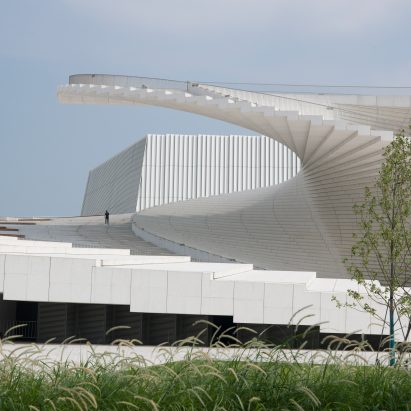
The giant spiral staircase of Snøhetta’s Shanghai Grand Opera House invites public access to the building’s roof.
This research context reveals a shared undercurrent of redefining architectural longevity and civic engagement, through both new construction and radical adaptation. The common thread is how robust structures, originally conceived for singular or industrial purposes, are being re-evaluated for their urban contribution and extended lifespan, whether for broad public access or extreme private enclosure. This collective re-evaluation challenges the default assumption of single-use, finite architectural lifespans.
While the industry often lauds iconic cultural structures for their symbolic weight, the true innovation in the Shanghai Grand Opera House lies not in its form as a distinct cultural landmark, but in its strategic blurring of public and private boundaries within a large-scale institutional program. This emphasis on an “accessible public realm” within a performance venue goes beyond mere programmatic addition; it represents a foundational shift in how civic buildings contribute to urban life. This contradicts the mainstream focus on monumental aesthetics, suggesting that architectural value increasingly resides in its capacity for porous social integration. This approach will influence urban planning policies in high-density cities, pushing for mandatory public access elements within large-scale private developments by early 2028.
A contrasting, yet equally potent, interpretation of structural longevity is seen in the conversion of former industrial and military sites. The prevailing view celebrates adaptive reuse as inherently sustainable and publicly beneficial, exemplified by transformations like the Tate Modern. However, the transformation of a former missile silo into the Survival Condo Project exposes adaptive reuse’s potential for perpetuating social division and resource hoarding, challenging the inherent ‘good’ narrative. The “luxury apartments” behind a “heavily armed guard” represent a material repurposing for extreme exclusion rather than communal benefit. This reveals a critical blind spot in how sustainability is often framed, overlooking the social equity implications of material and structural redeployment. Within the next three years, regulatory bodies will start distinguishing between adaptive reuse for community benefit and conversions serving exclusive private interests, possibly through differential tax incentives or planning approvals.
The commercial imperative for maximum profitable density, often at the expense of public space integration or long-term structural adaptability, actively resists architecture’s civic potential. This force prioritizes immediate return on investment over a building’s enduring urban responsibility or its capacity for future metamorphosis, creating structures that are resistant to evolving public needs. The heavily armed guard at the Survival Condo Project serves as a literal and symbolic gatekeeper against a shared future.
Architecture professionals should advocate for and implement ‘design for disassembly’ principles alongside rigorous adaptive reuse studies at every project inception, regardless of building type or client brief. This requires understanding the material lifecycle and potential future transformations of every structural component from day one, anticipating both civic repurposing and resource recovery.
TL;DR
Architectural longevity and urban responsibility now depend on designing adaptable structures for public benefit, resisting the pull towards privatized retreat.
Curated References
About this editorial — This piece was developed using AI-assisted research and curation across multiple industry sources. All analysis, opinions, and predictions represent the editorial perspective of JHDD. Sources are linked in the references section above.