JHDD Interior Report — 2026.10.15
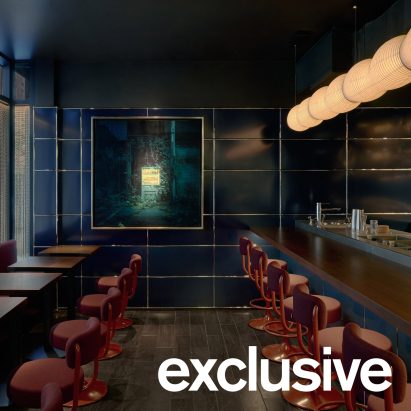
Josh Greenspan’s VV’s Cocktail Room in Manhattan, wrapped almost entirely in Steel Blue USM Haller modular shelving, represents a current preoccupation in spatial design.
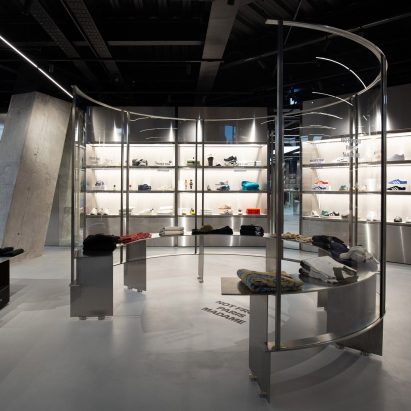
Across diverse projects from London to Malta, a distinct pattern emerges: the aggressive assertion of new material identities within pre-existing or highly constrained architectural volumes. This is not about passive adaptation, but a deliberate act of implanting distinct material systems and bespoke elements, forcing a new spatial dialogue. Whether it is Gundry & Ducker drawing on French dining culture for London restaurant Cassette or Didea creating a steel-clad streetwear store inside ZHA’s Mercury Tower, the approach emphasizes a decisive intervention that commands attention through specific material and structural choices.
Josh Greenspan’s VV’s Cocktail Room in Manhattan, wrapped almost entirely in Steel Blue USM Haller modular shelving, exemplifies this trend. The design choice creates a powerful, singular aesthetic statement through an industrially produced system. While conventional wisdom praises USM Haller for its clean lines, adaptability, and timeless quality, its near-total deployment in a compact, intimate setting like VV’s raises critical questions. The perceived efficiency and minimalist purity can, in practice, lead to a suppression of varied tactile experiences and a predictable spatial tension. This monolithic approach, while visually striking, risks reducing the inherent potential for human-scaled material interaction to a single, unyielding texture and uniform modularity, dictating rather than inviting human flow.
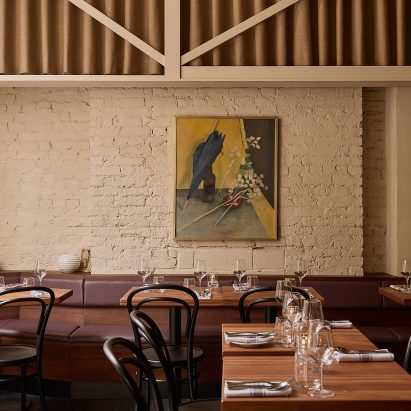
The industry often lauds such comprehensive system integrations as smart solutions for small footprints and brand consistency. However, a deeper analysis reveals that this approach can inadvertently flatten the human experience of a space. The constant visual rhythm and consistent material touch points of an all-USM environment, for instance, might offer a sterile perfection rather than a rich, evolving spatial narrative. This singular material approach, while appearing efficient, frequently neglects the subtle shifts in texture, acoustic quality, and inherent warmth that invite varied postures and extended engagement. Such uniformity can create an almost anti-tactile environment, where the eye perceives elegance, but the body finds little invitation for discovery or comfort beyond initial impression. By mid-2027, clients will increasingly demand environments that provide greater material friction and textural variety, moving away from such uniform applications in social spaces. This shift will favor layered designs that allow for diverse moments of engagement and sensory depth, such as the deliberate contrasts seen in Gundry & Ducker’s Cassette, where intricate detailing on a glass facade juxtaposes with historic masonry, rather than continuous, uninflected surfaces.
The strongest opposing force to this demand for nuanced material exploration is the relentless push for Instagrammable uniformity and the replication of “successful” aesthetics across multiple locations. This pressure from brand developers and certain hospitality groups, particularly those aiming for rapid global expansion, often prioritizes immediate visual recognition and scalable production over the complex, localized sensory experiences that differentiate truly memorable spaces. Their objective is frequently to control every visual element for marketing, effectively reducing the interior to a highly curated, often two-dimensional backdrop for social media, rather than an active participant in human flow and tactile discovery. This approach resists the granular detailing or bespoke craftsmanship evident in Formant Studio’s custom furniture for Nota Tavern, favoring generalized solutions.
Interior professionals should, this week, audit their material palettes for projects currently in concept or development with a critical eye. Move beyond primary visual appeal to actively consider the “wear-in” quality, acoustic properties, and haptic feedback of every surface a human might touch or encounter. Prioritize material combinations that offer deliberate contrasts in temperature, texture, and resilience, ensuring that human contact points encourage lingering, varied postures, and sensory engagement rather than merely reflecting light or providing a uniform, unchallenging surface. This means questioning the efficiency of a single system like USM Haller, and instead seeking the deliberate friction and material layering that enhances human flow and interaction, much like Mariel Lozano Studio’s custom interventions for compact spaces.
TL;DR
Designers are forcefully implanting specific material systems into spaces, creating strong aesthetics but risking flat human experiences.
Curated References
About this editorial — This piece was developed using AI-assisted research and curation across multiple industry sources. All analysis, opinions, and predictions represent the editorial perspective of JHDD. Sources are linked in the references section above.