JHDD Interior Report — 2026.09.14
Anam Design Studio’s addition of a red travertine kitchen to an East Sussex home signals a clear return to materially dense and spatially specific environments.
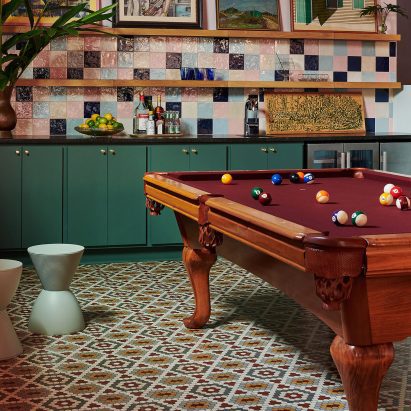
This deliberate carving of intimate, sensorially rich zones for defined human activities emerges as a recurring theme across varied projects. Whether it is the club-like atmosphere intended by Anam Design Studio, the precise leisure function implied by the availability of billiard tables, Badweather’s mobile off-grid bathhouse “Soak” built for specific communal rituals, or Merckx-Holvoet Architecten’s V Penthouse designed to envelop guests in the sandy tones of the North Sea, each demonstrates a powerful commitment to curated experience over open-ended flexibility.
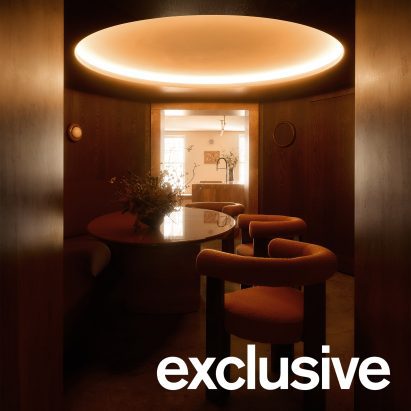
The industry frequently advocates for expansive, light-filled spaces, often driven by a perceived need for broad appeal or future adaptability. Anam Design Studio’s approach, particularly with its dark dining room featuring rounded timber walls, directly contradicts this prevailing sentiment. This design is not about airy openness but about deliberate enclosure and concentrated warmth, crafting a distinct atmosphere that prioritizes deep immersion. The use of tactile stone surfaces and deep wood tones creates a spatial tension, inviting occupants into a specific kind of interaction, rather than merely accommodating any activity. This focused design ethos understands that genuine luxury often resides in the conviction of a space’s purpose and its uncompromised material narrative.
Such projects move beyond superficial aesthetics, creating environments where materiality itself dictates the emotional register and human flow. The rounded timber walls in the Anam Design Studio project, for example, do more than delineate space; they soften boundaries, absorb sound, and invite touch, establishing a distinct haptic quality. This deliberate sculpting of spatial tension through material choice and form implies a future where experiential density overrides volumetric extravagance. It suggests that by late 2027, the most sought-after commissions will shift focus from maximizing floor area to intensifying the sensory and tactile impact within smaller, highly articulated volumes.
The counter-current to this trend stems from the commercial imperative for design scalability and broad market appeal. Large developers and mass-market hospitality brands often resist highly specific, materially rich solutions due to perceived limitations in maintenance, cost, and universal desirability. Their default is often towards standardized palettes and adaptable layouts, which, while efficient for volume production, dilute the profound sensory engagement seen in projects like Badweather’s Soak, which embraces an off-grid, constrained, and mobile existence for a highly specific experience.
A working interior professional should, this week, select a single design problem—for instance, a reading nook or a defined conversation area—and approach it by first selecting three contrasting tactile materials. Explore how the inherent properties of these materials—their texture, weight, and acoustic qualities—can be layered to generate a specific spatial tension and direct human flow for that single activity, rather than beginning with a layout or visual scheme.
TL;DR
The future of luxury design is characterized by intense sensory immersion and precisely directed human flow, achieved through specific materiality and spatial tension.
Curated References


About this editorial — This piece was developed using AI-assisted research and curation across multiple industry sources. All analysis, opinions, and predictions represent the editorial perspective of JHDD. Sources are linked in the references section above.