JHDD Interior Report — 2026.10.03
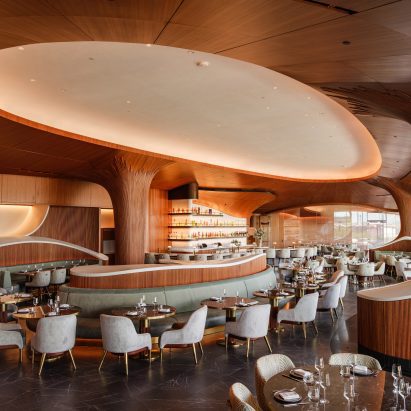
Rockwell Group’s design for the Skywalker Grill at the Lucas Museum of Narrative Art includes no 90-degree angles.
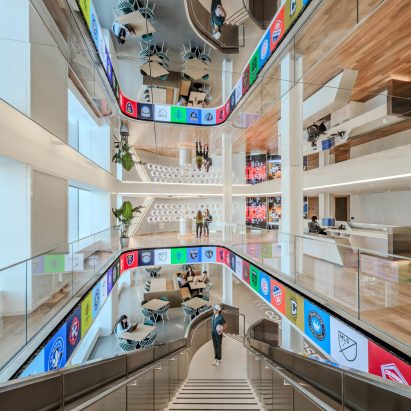
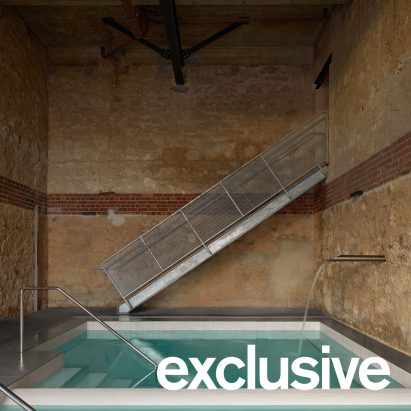
This deliberate rejection of orthogonal forms, alongside Rezen’s use of rough brick walls at Alchemy Saunas and TPG Architecture’s “office as stadium” concept for Major League Soccer, signals a deeper industry current. Designers are actively shaping spatial tension and human flow through primary material conditions and evocative forms. The goal is no longer merely enclosure but orchestrated experience, often leveraging the inherent characteristics or historical resonance of materials to guide movement and perception, creating distinct tactile qualities in environments from workplaces to wellness centers.
Rezen’s Alchemy Saunas in Fremantle, Australia, exemplify this shift by transforming a 1903 stable and cellar into a wellness center with “raw and direct” appeal. The rough brick walls and arched openings evoke a Roman bathhouse, providing a specific, historical texture. The prevailing industry assumption often links luxury wellness with pristine, minimalist surfaces and newly fabricated elements designed for clinical purity. However, this approach demonstrates that a heightened sense of luxury and well-being can be achieved through the deliberate exposure of a building’s past, focusing on the tactile imperfections and inherent character of aged materials. The material choices dictate an embodied, less sterile flow, grounding the user in history rather than abstract modernity. This prioritizes deep sensory engagement over superficial sheen.
The strategic implementation of material and form to manipulate spatial experience will evolve beyond historical pastiche. TPG Architecture’s “office as stadium” for Major League Soccer, mirroring the dynamics of a soccer pitch, illustrates this push for engineered energy. This isn’t about decorative themes; it is about embedding active, kinetic narratives into static architecture. Within two years, this method will lead to an increased demand for computational design tools that predict and simulate human physiological and psychological responses to non-traditional spatial geometries and material textures, particularly in hospitality and high-density residential developments, moving beyond simple circulation analysis to ’emotional flow’ mapping.
This focus on raw materiality and complex spatial dynamics faces resistance from construction industries still optimized for standardized, easily reproducible components and finishes. Procurement chains and contractor expertise often favor clean lines and uniform surfaces, making the bespoke installation of salvaged or imperfect materials, or the precise execution of biomorphic forms without 90-degree angles, more costly and logistically challenging. The ingrained pursuit of efficiency in large-scale building often devalues the deliberate friction and complexity required to achieve unique tactile and spatial tensions.
Interior professionals should begin specifying material palettes that incorporate at least one deliberately “imperfect” or historically resonant element, such as reclaimed timber, natural stone with visible veins, or handcrafted tiles, for their next project. This means actively seeking out suppliers and craftspeople who value unique material character over factory uniformity. During client presentations, articulate how the chosen material’s texture, patina, and potential for wear contribute to the spatial tension and human experience, rather than focusing solely on its aesthetic appeal or durability metrics.
TL;DR
Intentional materiality and non-orthogonal forms are defining richer spatial experiences, challenging conventional luxury definitions.
Curated References

About this editorial — This piece was developed using AI-assisted research and curation across multiple industry sources. All analysis, opinions, and predictions represent the editorial perspective of JHDD. Sources are linked in the references section above.