JHDD Architecture Report — 2026.09.25
The Student Center & Dining Commons by Herzog & de Meuron at Amherst College, which utilises the existing concrete foundation of a former brutalist building, highlights a growing tension in contemporary design practice.
A distinct pattern emerges from recent industry news, one that pits authentic material engagement against superficial representation or virtual abstraction. While projects like House Ersland & Skeie demonstrate a grounded integration with challenging natural bedrock in Stavanger, other developments, such as VitrA Tiles’ Metacode series, focus on emulating the look of concrete with metallic finishes. This reveals a schism: between architecture that directly responds to and reclaims existing physical substance, and design that prioritizes a new aesthetic layer over structural or historical continuity.
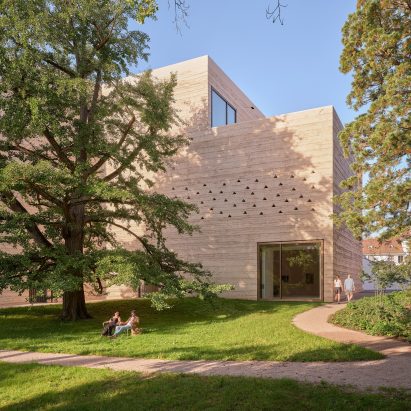
The conventional architectural narrative often prioritizes novel structural forms or virgin material innovations. Herzog & de Meuron’s approach at Amherst College, utilising the existing concrete foundation of the Merrill Science Center for its mass-timber structure, challenges this. This move demonstrates that structural philosophy can find its most responsible expression not in new ground-up construction, but in deep engagement with existing urban fabric and its embodied carbon. Peter Zumthor’s expansion of the Fondation Beyeler, with its rammed-concrete art gallery designed to nestle into the park setting, reinforces this commitment to material honesty and contextual sensitivity, prioritizing the inherent qualities of the material and its placement over overt architectural statement.
While VitrA Tiles introduces Metacode, a series emulating concrete with metallic updates, this aesthetic play illustrates the divergence. The mainstream might applaud the ability to mimic materials and create new surface effects, yet the true material innovation for sustainability lies in reducing resource extraction and waste, as shown by Herzog & de Meuron. Similarly, Meta’s announcement of camera-free Ray-Ban Meta Audio glasses focuses on a virtual layer of experience, further detaching engagement from tangible physical space. By mid-2028, leading urban development policies will begin to mandate comprehensive structural and material audits of adjacent derelict or underutilized structures as a preliminary design phase for any new project, shifting focus from empty lots to existing footprints.
The primary resistance to this grounded approach comes from development models that value rapid turnover and maximum developable area over site-specific architectural integration. Standardized construction practices and the financial instruments backing speculative real estate often deter the bespoke, often more complex, initial analysis required for significant structural reuse. Furthermore, the persistent allure of a “blank slate” for developers and some clients, fueled by marketing narratives of pristine newness, actively works against a deeper engagement with the past.
Every architecture professional should perform a detailed existing conditions survey, including structural evaluations, for any project site, even if it appears to be a clear plot. This should precede any conceptual design work, ensuring potential for foundational reuse or integration with surrounding urban structures is explored from the outset.
TL;DR
Genuine material innovation and urban responsibility are found in the intelligent reuse of existing structures and honest engagement with site context, not solely in novel aesthetics or digital abstraction.
Curated References



About this editorial — This piece was developed using AI-assisted research and curation across multiple industry sources. All analysis, opinions, and predictions represent the editorial perspective of JHDD. Sources are linked in the references section above.