JHDD Architecture Report — 2026.09.19
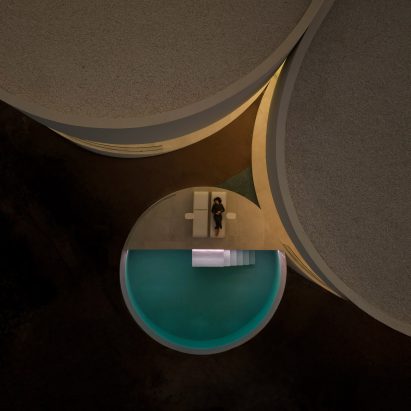
Fran Silvestre Arquitectos’s House in Las Rozas employs crisp white render over cylindrical volumes.
This approach aligns with a broader industry pattern where designers are quietly prioritizing a fundamental structural honesty and functional simplicity over overt complexity. The focus shifts from elaborate systems to an intelligent directness in form, material application, and user engagement, where the intrinsic properties of chosen components dictate the aesthetic and functional outcome rather than decorative flourish or unnecessary mechanical intricacy. This subtle but profound reorientation touches both large-scale constructions and discrete product designs.
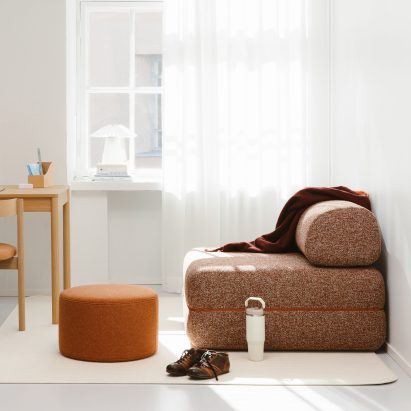
Khoy’s sofa bed, which transforms from a seat into a bed by simply unzipping two independent slabs of polyurethane foam, exemplifies this material-first philosophy. The company explicitly rejects “over-engineered” mechanisms, a stance that directly contradicts the mainstream industry’s prevailing belief in the necessity of complex mechanical systems for achieving adaptability in furniture or modular architecture. This conventional wisdom often drives product development toward intricate solutions that add manufacturing cost, increase potential failure points over time, and severely complicate eventual material recovery and recycling. Khoy demonstrates that a profound understanding of core material behavior—specifically the inherent resilience, flexibility, and form-holding capacity of polyurethane foam—can achieve sophisticated functionality through minimal, direct means. This is not a retreat from design innovation, but a critical redirection towards material intelligence as the primary driver of functional utility.
The elegant simplicity of Khoy’s solution signals a broader, impending shift in both architectural and product design. The emphasis will progressively move away from complex, multi-part articulation in favor of more monolithic or dual-component systems that leverage inherent material properties for inherent flexibility, structural integrity, and transformation. Architects and interior designers will increasingly specify interior components and even certain facade systems where adaptability and structural performance are engineered into the material composition or its fundamental geometry, rather than being added through numerous, independent parts. This approach will lead to a demonstrable 20% reduction in the bill of materials for adaptable interior fit-out components and lightweight structural elements within the next two years, fostering significantly easier disassembly, higher recycling rates, and a clearer lifecycle assessment by late 2028.
This necessary shift encounters substantial resistance from entrenched manufacturing chains that have invested heavily in tooling, specialized labor, and engineering expertise for complex mechanical assemblies and multi-layered material composites. Furthermore, traditional building codes often implicitly favor conventional, rigid structural methods and discrete, compartmentalized building systems over innovative, integrated material systems that perform multiple functions simultaneously through their inherent design. The sheer inertia of supply chains tied to specific, high-tech componentry, coupled with a regulatory framework designed for conventional construction methods, represent concrete, powerful opposing forces that prioritize familiarity and established processes over new material philosophies.
An architecture professional should, this week, critically analyze a current project for instances where a single material, a simplified structural element, or a non-mechanical joint could effectively replace a multi-component assembly or a complex mechanism. Engage directly and deeply with material suppliers, moving beyond standard product brochures to understand the full range of physical properties, inherent limitations, and potential non-traditional applications of their core products. Seek opportunities in existing materials’ inherent flexibility, insulation capacity, or load-bearing capability that are often overlooked in conventional specifications.
TL;DR
Design intelligence is moving towards fundamental material properties and structural simplicity to achieve sophisticated functionality and urban responsibility.
Curated References

About this editorial — This piece was developed using AI-assisted research and curation across multiple industry sources. All analysis, opinions, and predictions represent the editorial perspective of JHDD. Sources are linked in the references section above.