JHDD Architecture Report — 2026.09.15
The dissolving washbasin presented by Design Academy Eindhoven and Kaldewei at Berlin’s Currents festival represents a critical shift in how designers approach material longevity.
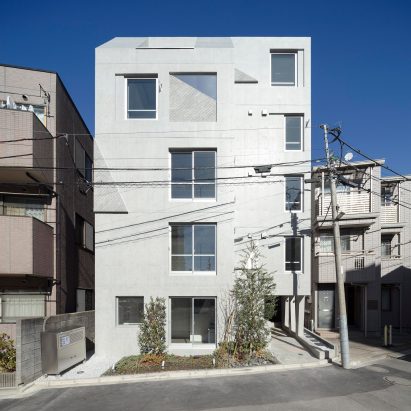
A pervasive trend connects recent projects, characterized by a deep engagement with embedded constraints rather than their circumvention. Whether it is Ryuichi Sasaki Architecture responding to Tokyo’s urban grain with trapezoidal concrete motifs for Shin Nakano Trapezoidal, or Studio Saar employing police and rain shields to construct The Pangolin Shield, a direct, often challenging, dialogue with existing conditions and materials is emerging. This extends beyond simple context-specificity, encompassing a profound re-evaluation of architectural intent, material cycles, and structural permanence in response to tangible limitations.
The projects from Design Academy Eindhoven, particularly the dissolving washbasin crafted from soap, embody a structural philosophy that directly confronts the conventional wisdom of architectural permanence. Mainstream industry thought often equates quality and value with durability, advocating for materials designed to withstand centuries. However, this perspective overlooks the environmental burden of extracting, processing, and ultimately disposing of such materials, especially when functions and technologies evolve rapidly. The dissolving washbasin, while conceptual, pushes for a paradigm where an object’s end-of-life is designed in from the beginning, challenging the assumption that all architectural components must aspire to eternal existence. This approach prioritizes resource circularity and adaptability over brute material tenacity. It suggests that a structure’s material honesty can also mean acknowledging its eventual, perhaps intended, dissolution.
The implication for urban responsibility and material innovation is profound. Instead of seeking to build structures meant to last indefinitely, the focus shifts to designing for purposeful lifecycles, where components can be reabsorbed, composted, or remanufactured. This contradicts the prevailing client demand for “maintenance-free” materials that only delay the inevitable issue of waste. A more sustainable future requires architects to champion materials that combine robustness with responsibility throughout their entire existence, including their planned degradation. By late 2027, the industry will see a measurable increase in architectural specifications for building components designed for biological or technical nutrient cycles, moving beyond simple recyclability to true circularity.
The primary resistance to this shift comes from established supply chains and financial models that reward high-volume production of durable, often composite, materials with complex end-of-life scenarios. Concrete manufacturing, as seen in the Shin Nakano Trapezoidal project, exemplifies a powerful industry with ingrained practices that prioritize strength and longevity, making rapid material innovation and lifecycle-conscious alternatives challenging to implement at scale. Additionally, client expectations, often shaped by marketing emphasizing permanence and investment value, also resist embracing the beauty and practicality of designed obsolescence or circular material flows.
Architecture professionals should actively engage with material suppliers this week to inquire about specific end-of-life pathways for every major component specified, moving beyond generic recyclability claims. They must question the structural necessity of over-engineered permanence and explore how temporary or demountable systems could meet project goals while reducing future waste, applying this rigor even to seemingly minor elements.
TL;DR
Architects must design for purposeful material lifecycles, challenging the industry’s default toward indefinite permanence.
Curated References



About this editorial — This piece was developed using AI-assisted research and curation across multiple industry sources. All analysis, opinions, and predictions represent the editorial perspective of JHDD. Sources are linked in the references section above.